
Charging an EV at home
March 2026
Thinking about installing a home charger for your EV?
You’re not alone. Home charging is one of the most convenient ways to keep your EV powered and ready for daily use—and for many drivers, it’s the preferred option. But is it the right solution for your lifestyle?
There’s no one-size-fits-all answer. If you own a home (with or without a garage), installing a Level 2 charger can be a smart investment. It’s often easier, cost-effective, and means charging is readily available.
But not everyone has that setup. Maybe you rent, live in an apartment or condo, or don’t have access to a dedicated parking space. If this is you, don’t fret – we have some suggestions below. Or maybe your daily commute is greater than the vehicle’s estimated range. In these situations, installing a home charger might take a little more research and permission from your landlord, or it might be something that isn’t feasible. That’s why it’s important to explore your charging options before taking the next step in your EV journey. Whether you’re ready to install or still weighing your options, understanding what it takes to charge your vehicle at home is a great place to start.
Before you begin, talk to an electrician.
Consulting a licensed electrician early on can help you avoid potential safety issues and expensive surprises. That’s because it’s important to understand the capacity and condition of your home’s electrical system before getting too far into the process. Depending on your situation, you may need to upgrade your electrical panel, install a separate panel, switch to a different gauge of wiring, or even redo parts of your home’s electrical system to meet code—all on top of the cost and effort of installing an EV charger.
If you’re looking for guidance on who to contact or have questions about home charging solutions that may fit your needs, the team at Qmerit can help. Qmerit helps take the guesswork out of home charger installation by connecting you with certified professionals who understand EV charging requirements and can provide customized installation pricing options in three steps.
To learn more and request a home assessment, click here.
What are my options for home charging?
We know there are a lot of charging options in the market, and all of this might sound a little overwhelming—especially if you’re new to the EV space. So, why not start with the basics?
There are different types of charging connectors and ports—called charging standards—that can vary by vehicle manufacturer. Volkswagen EVs use the J1772 charging standard for Level 1 and Level 2 charging. That means that only home chargers that use the J1772 standard can be used. With me still?
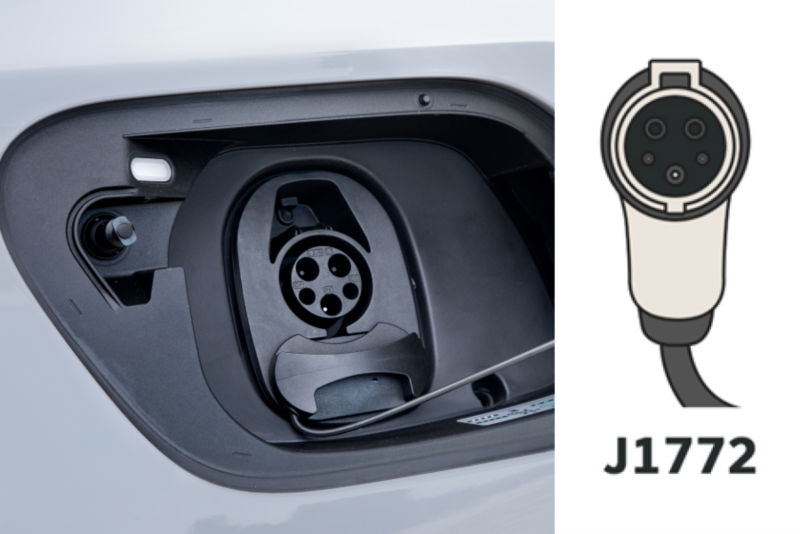
You may see aftermarket adapters for home charging that claim to allow J1772-equipped vehicles to connect to home chargers with different charging standards. However, unapproved aftermarket adapters are not permitted by Volkswagen. Improper use may result in damage, safety hazards, injuries, or an increased risk of fire. Plus, the use of an unapproved adapter may also impact warranty eligibility if it leads to failures or consequential damage to vehicle components.
Now that we’ve sorted out the charging standards, let’s dig a little deeper.
There are Level 1 chargers which plug into a standard household outlet (120V), but because it is the s-l-o-w-e-s-t charging method, many EV owners use it when they need to “top off” their charge overnight or if they don’t have lengthy commutes.
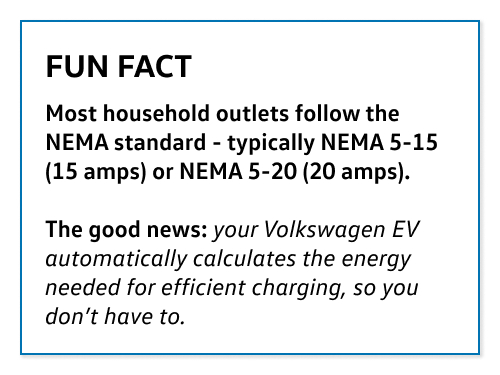
Most of our EV owners will instead opt for a Level 2 charger because it can charge the battery much quicker than Level 1. Level 2 chargers can either be hardwired to your home’s electrical system via a dedicated 240V circuit from your electrical panel or can be plugged into a NEMA 14-50 outlet (preferably one that’s designed with higher robustness for EV-use).
- The hard-wired option is more permanent and can support higher amperage (typically 48A or more), which could mean higher charging speeds.
- The plug-in option, which supports a maximum amperage of approximately 40A, gives you more flexibility. Renters, frequent travelers, and owners who expect to move, upgrade their charger, or use the outlet for other purposes—like powering an RV or appliance—may find the plug-in option more convenient.
IMPORTANT: Both the hard-wired and plug-in options should have a dedicated circuit with no other outlets and should be installed by a licensed electrician. Equally important is that the charger has been safety tested and certified to meet UL (Underwriters Laboratories) standards.

- 2.Illustration of NEMA 14-50 outlet.
Another point to consider (no matter which charger you choose) is accessibility. Do you have enough cable length to reach the vehicle’s charge port? Can you easily drive up to the charger and plug-in, or do you need to reverse into your parking space every time you need to charge? Mapping out the “where and how” can help guide your installation decisions.
How will I know if I need more power to charge my EV?
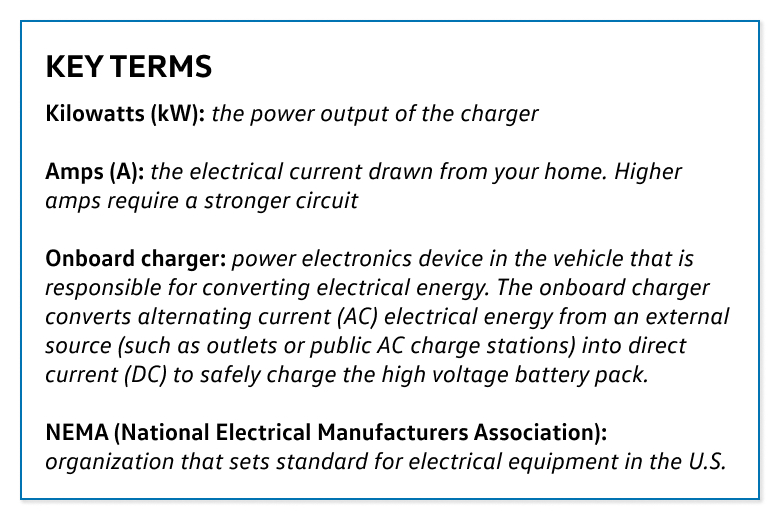
If charging feels slower than expected, it may be related to amperage – the amount of electrical current your Level 2 charger can supply. Level 2 chargers typically provide anywhere from 16-48 amps, and in general, higher amperage can support faster charging. It’s also important to remember that depending on where you live, your home’s voltage can vary. Most single-family homes supply 220-240V, while many apartment or condo buildings provide around 208V, which can slightly reduce charging speed. Your charger communicates its maximum available current to the vehicle, and your EV can draw up to – but never more than – that limit.
The good news? Your Volkswagen EV gives you some control of the charge current within the battery settings. If you select a reduced charge current, the vehicle will limit it so the charger only draws 10 amps of power to reduce the electrical load. But when you have maximum charge current set, it will draw up to the charger’s maximum amperage.
Choosing a Level 2 charger…
When shopping around, you’ll see numbers like 5.2 kW, 7.2 kW, 9.6 kW or 11 kW. Think of these numbers as “charging speed”—higher numbers mean faster charging, but only up to what your vehicle can handle.
To understand your vehicle’s charging limitations, check your EV’s onboard charger rating. This determines the maximum AC power your car can accept. You can find this rating on the Monroney Label (window sticker), or by asking your dealer.
Many newer Volkswagen EVs have onboard chargers that support up to 11 kW AC charging. But say, for instance, the onboard charger maxes out at 7.2 kW. In this case, installing an 11 kW charger at home won’t speed things up—but it can future-proof your setup in the event your next EV can charge at a higher rate.
Equally important is the maximum output of the AC charger. If your charger has a maximum output of 7.2 kW, even if your car can handle more, the most that your vehicle would be able to receive is what the charger can give.
So, as you explore your options, think about a few key things: what the vehicle and charger can handle, what your home’s electrical setup can support, and how much you typically drive. Together, these will help you figure out how often you’ll need to charge. For example, if you drive 30 miles a day, a 5.2 kW charger could easily keep up overnight.
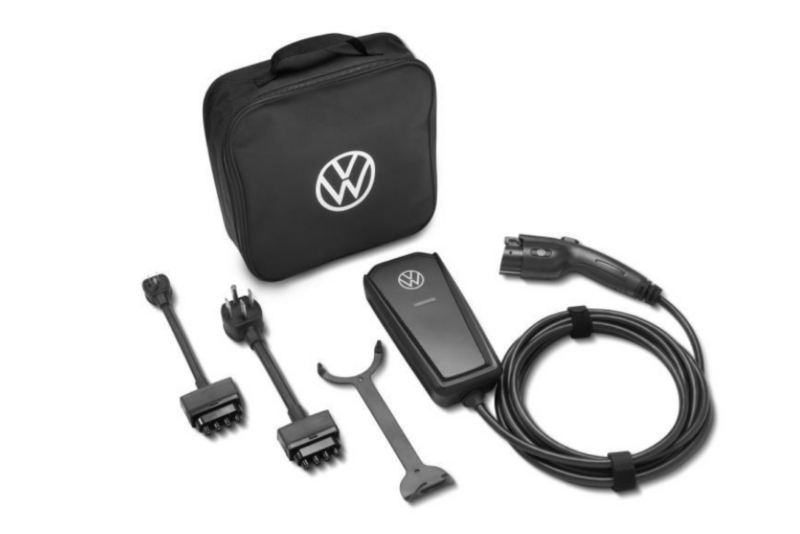
If you’re on the fence about which charger to get, or if your Volkswagen EV already comes with it, the portable 2-in-1 mobile EV charge cable is a great home charging option. It gives you the best of both worlds by providing the choice of Level 1 and Level 2 charging, depending on your needs.
The 2-in-1 mobile EV charge cable supports charging from either a 120V or 240V outlet and is standard with the 2026 ID.4.
While it may be considered extremely slow, Level 1 charging (achieved using the 120V plug connector for a maximum of around 3 miles of range added per hour) could prove to be enough if your daily driving demands are low.
What if you’re renting or living in an apartment or condo?
You still have options. Charging in multi-unit dwellings can be more complex and may take a bit of research—but it’s not impossible.
You may find a plug-in charging option is an ideal solution, but if you’d like to explore a hard-wired option, start by talking to your property manager or Homeowners Association (HOA) to understand feasibility and what it may take to install an EV charger. If it’s appropriate, it might be useful for your property manager to consider shared charging stations or smart load-balancing systems that allow multiple residents to charge without major electrical upgrades.
And be sure to check your state laws too, as some states may have “right-to-charge” laws that support tenant requests.
If a home charger cannot be installed on your property, or if charging at work isn’t an option, the other alternative is public charging. The charging infrastructure in the U.S. continues to grow, especially as we see an increase in EV adopters. If you reside in an area with multiple public charging options, or if there are compatible charge stations along your daily commute, that might be enough. But it’s important to make that call as early-on as possible.
The bottom line.
Home charging is meant to make life easier and take the stress out of keeping your EV road ready. Charging at home gives you the flexibility to charge on your schedule and means one less stop on your way to work or coming home. Plus, you may be able to take advantage of off-peak electricity rates which could lead to cost-savings over time. The bottom line - it’s just awesomely convenient.


